
Table of Contents
Denmark is one of the European countries where international workers can apply for jobs through several work and residence permit schemes. For workers outside the European Union, European Economic Area and Switzerland, getting a Danish job offer is usually the most important first step. However, not every job can automatically lead to a work permit.
In 2026, Denmark has several routes for foreign workers, including the Pay Limit Scheme, Supplementary Pay Limit Scheme Positive Lists and Fast-Track Scheme. The right route depends on your job, qualifications salary employer and the conditions attached to the specific scheme.
The Danish Agency for International Recruitment and Integration, known as SIRI, is responsible for the processing many residence and work permit applications. The rules and salary thresholds can change, so applicants should always check the current requirements before the submitting an application.
What Are Denmark Visa Sponsorship Jobs?
When people search for “Denmark visa sponsorship jobs,” they normally mean jobs where a Danish employer is willing to hire a worker from outside Denmark and support the employment process required for a residence and work permit.
Denmark does not have one single “visa sponsorship visa.” Instead, international workers may qualify through different work schemes.
A job offer alone does not guarantee a work permit. The employment must meet the conditions of the relevant scheme, including salary, qualifications, job title, employment conditions and other requirements.
For many applicants, the employer plays an important role because the employment contract or job offer is required as part of the application.
Denmark Work Visa Routes in 2026
There are several important pathways for international workers in Denmark.
The most commonly discussed options are the Pay Limit Scheme, Supplementary Pay Limit Scheme, Positive List for People with a Higher Education, Positive List for Skilled Work, and the Fast-Track Scheme.
Each route has different conditions, so applicants should select the scheme that actually matches their employment situation instead of applying under a route simply because it appears easier.
Denmark Pay Limit Scheme 2026
The Pay Limit Scheme is one of the main routes for foreign workers who have been offered a highly paid job in Denmark.
For applications submitted in 2026, the minimum annual salary under the Pay Limit Scheme is DKK 552,000, equivalent to DKK 46,000 per month. The salary threshold is regulated annually.
One important feature of this scheme is that there is no requirement for the job to belong to a specific professional field. There is also no general requirement for a particular educational background under the Pay Limit Scheme itself.
However, the applicant must still have a genuine job offer and the salary and employment conditions must correspond to Danish standards.
This route can therefore be relevant to international professionals whose Danish job offer reaches the required salary level, even when their occupation is not listed on a shortage list.
Supplementary Pay Limit Scheme 2026
Denmark also has a Supplementary Pay Limit Scheme.
For 2026, the minimum annual salary under this scheme is DKK 446,000, which is approximately DKK 37,166.67 per month.
Like the regular Pay Limit Scheme, a specific educational background or professional field is not generally required by the scheme itself.
However, the supplementary route has additional conditions compared with the standard Pay Limit Scheme. Therefore, applicants should carefully check the current rules before relying on this route.
Salary calculations are also specific. Depending on the scheme, certain guaranteed salary components, pension contributions and paid holiday allowance can be included, while benefits such as free accommodation, paid phone or similar benefits may not necessarily count toward the required salary amount.
Denmark Positive List for International Workers
Another important pathway is Denmark’s Positive List.
The Positive Lists contain occupations where Denmark has identified shortages of qualified workers. There are two main lists:
- Positive List for People with a Higher Education
- Positive List for Skilled Work
If your job is included on the relevant list and you meet the requirements, you may be able to apply for a Danish residence and work permit under that scheme.
The lists are updated during the year, so applicants should not rely on an old list found on another website.
Positive List for Higher Education
The Positive List for People with a Higher Education is designed for occupations experiencing a shortage of qualified professionals.
The applicant must have an educational background that qualifies them for the job being offered. A job title may be included because Denmark has identified a national or regional shortage for that occupation.
On 1 July 2026, the updated Positive List for People with a Higher Education contained 164 job titles.
This means qualified professionals should check the current list before applying because the occupations can change over time.
Positive List for Skilled Work
The Positive List for Skilled Work is designed for skilled occupations where Denmark has a shortage of qualified workers.
As of the 1 July 2026 update, this list contained 63 job titles. The list is updated twice a year, on 1 January and 1 July.
Applicants should also understand that being on the Positive List does not mean every salary automatically qualifies. SIRI uses Danish wage statistics when assessing whether the offered salary and employment conditions correspond to Danish standards. Updated wage statistics for applications under the Skilled Work list took effect on 1 August 2026.
Also read:Senior Tools Engineer Jobs 2026 in Germany Great Opportunity : Visa Sponsorship
Denmark Fast-Track Scheme 2026
The Fast-Track Scheme is another important option for international workers.
It is available when the applicant has been offered employment by a company that is certified by SIRI for the Fast-Track Scheme. The purpose is to make recruitment of foreign workers faster and more flexible for certified companies.
The Fast-Track Scheme has five tracks:
- Pay Limit Track
- Supplementary Pay Limit Track
- Short-Term Track
- Researcher Track
- Educational Track
The exact requirements depend on which track is used.
For the regular Fast-Track processing route, the normal processing time is currently around 1 month, although cases requiring additional information can take longer. For eligible visa-required applicants, Quick Job Start can normally allow a decision in about 10 days when the required conditions are fulfilled, including payment, complete information and biometrics.
Therefore, applicants should not assume that every Fast-Track application will automatically be approved within two or three weeks.
Which Jobs Can International Workers Target?
The best opportunities depend on the current Danish labour market and the applicant’s qualifications.
International applicants may consider areas such as engineering, information technology, healthcare, construction-related skilled work, science, technical occupations, research, manufacturing and other professional fields where employers have difficulty finding qualified workers.
However, the exact occupation list changes. A job that qualifies today may not necessarily remain on a Positive List later.
For this reason, applicants should start by checking whether their occupation appears on the current Positive List or whether the salary makes another scheme, such as the Pay Limit Scheme, possible.
Main Requirements for Denmark Work Sponsorship
The exact requirements depend on the scheme, but international workers should normally be prepared to provide documents relating to their identity, employment and qualifications.
Common documents can include a valid passport, employment contract or job offer, proof of relevant education, authorisation where required, evidence of salary or benefits where applicable, and documentation showing that the application fee has been paid.
For Positive List applications, SIRI specifically lists documents such as the fee receipt, passport copies, employment contract or job offer and documentation of education relevant to the offered job. Authorisation documentation may also be required for regulated professions.
The employment contract should also provide the required information about the job and employment conditions.
Denmark Work Visa Application Process
The process normally starts after you receive a genuine Danish job offer.
Step 1: Find a Suitable Danish Job
First, search for jobs that are open to the international applicants.
Look for positions that match your professional experience and qualifications. If possible, check whether the occupation appears on the current Positive List or whether the expected salary can meet one of the Pay Limit routes.
Do not apply for jobs simply because a website describes them as “visa sponsorship jobs.” The actual employment conditions and work permit scheme are what matter.
Step 2: Receive a Genuine Job Offer
After an employer selects you, you should receive an employment contract or formal job offer.
Review the salary, working hours, position, workplace and other employment conditions carefully.
The salary is particularly important because different Danish work permit schemes have different requirements.
Step 3: Identify the Correct Work Scheme
Once you have the offer, determine which scheme applies.
For example, a high-salary position may qualify under the Pay Limit Scheme, while a shortage occupation may qualify through a Positive List.
If the employer is certified by SIRI the Fast-Track Scheme may also be available if the employment meets the requirements of one of the its tracks.
Step 4: Create a Case Order ID and Pay the Fee
For many work permit applications, the process includes creating a case order ID and paying the required processing fee.
The standard SIRI processing fee for work cases in 2026 is DKK 6,810.
Applicants should keep the payment receipt because proof of payment may be required as part of the application.
Step 5: Submit the Application
Depending on the scheme, the employee and employer may each complete part of the application.
The AR1 application can be used for several work schemes. In an AR1 application, the employer normally completes the first part before the employee completes their section. Alternatively, under AR6, an employer can handle the application when the employee grants the required power of attorney.
Step 6: Provide Biometrics
Applicants who need a residence permit normally have to provide biometric information, including a facial photograph and fingerprints.
Biometric requirements and where they can be recorded depend on the applicant’s circumstances and application route.
Applicants should complete this step according to the instructions provided by SIRI after submitting the application.
Step 7: Wait for the Decision
Processing time depends on the work scheme.
For example, the current normal processing time shown by SIRI is around 1 month for the Pay Limit Scheme, while the Positive List for Skilled Work has a normal processing time of around 3 months.
Fast-Track applications can be quicker in eligible cases, especially where Quick Job Start requirements are fulfilled.
Processing times are not guarantees because SIRI may request additional information.
How to Find Denmark Visa Sponsorship Jobs
International workers should focus on employers that genuinely recruit workers from outside Denmark and understand the relevant work permit schemes.
The official Work in Denmark service can be useful for exploring employment opportunities and information about working in Denmark. Applicants can also research companies directly and the check whether a company appears on SIRI’s list of certified companies if they are interested in the Fast-Track route.
SIRI maintains a list of companies certified for the Fast-Track Scheme. The list includes Danish companies from different industries.
A practical approach is to search for a specific occupation rather than searching only for the phrase “visa sponsorship.”
For example, an engineer could search for Danish engineering vacancies, then check whether the employer accepts international applicants and whether the position could qualify under an appropriate work permit scheme.

Be Careful With Denmark Job Scams
International workers should be especially careful when searching for sponsorship jobs online.
A website or social media account claiming to provide a guaranteed Danish job and visa for a large upfront payment should be treated with caution.
A legitimate employer should provide clear employment information, including the position, salary and employment conditions.
Applicants should also understand that a work permit is not something a private agent can simply guarantee. The application must meet the official immigration requirements and is assessed by the relevant Danish authorities.
Never assume that paying an agent guarantees employment or residence in Denmark.
Can You Bring Your Family to Denmark?
In many circumstances, workers holding a Danish residence permit may be able to apply for residence for accompanying family members, depending on the rules of their specific permit.
Family applications have their own requirements and fees, so workers should not assume that family members automatically receive residence simply because the main applicant has a work permit.
Applicants planning to relocate with a spouse or children should review the current accompanying-family rules before making travel arrangements.
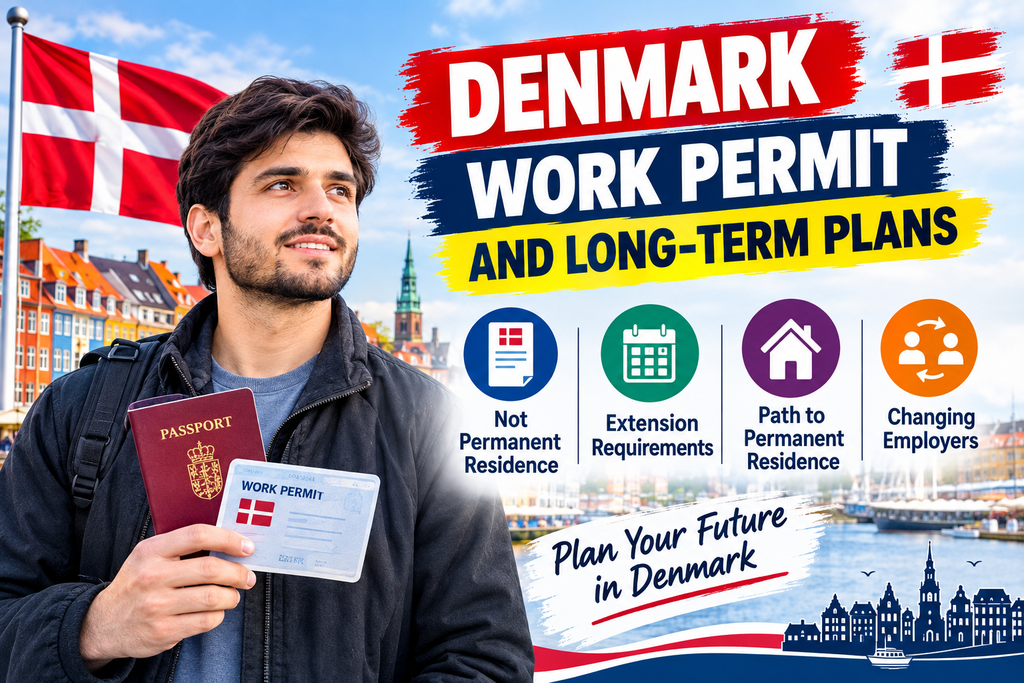
Denmark Work Permit and Long-Term Plans
A Danish work permit should not automatically be treated as permanent residence.
The initial residence and work permit is normally connected to the employment and the particular scheme under which it was granted. Conditions for extension and long-term residence are separate matters.
Workers who want to remain in Denmark for many years should therefore understand the requirements for extending their permit and, if eligible, eventually applying for permanent residence.
Changing employers can also have immigration consequences depending on the permit type. Workers should check the rules before starting a new job rather than assuming that every Danish work permit allows unrestricted employment.
Common Mistakes to Avoid
One common mistake is applying for a job without checking whether the position can support a work permit.
Another mistake is using an old Positive List. Denmark updates the lists, and the July 2026 update changed the number of occupations included.
Applicants should also avoid assuming that every job described as “sponsorship available” online will qualify. The employer and job must satisfy the requirements of the applicable scheme.
Salary is another important area. Meeting a salary threshold does not mean the application is automatically approved. Employment conditions and other requirements still have to be the satisfied.
Finally, applicants should make sure their documents are complete and consistent. Missing information can delay processing.
Final Thoughts
Denmark offers several routes for international workers who want to work legally in the country in 2026. The most important pathways include the Pay Limit Scheme, Supplementary Pay Limit Scheme, Positive Lists and Fast-Track Scheme.
The 2026 Pay Limit Scheme requires a salary of at least DKK 552,000 per year, while the Supplementary Pay Limit Scheme requires at least DKK 446,000 per year, subject to the conditions of the each scheme.
For applicants with an occupation on a current Positive List, this can provide another route to a Danish residence and work permit. As of July 2026, Denmark’s Positive List for People with a Higher Education contains 164 job titles while the Positive List for Skilled Work contains 63.
The Fast-Track Scheme can also be useful when the employer is certified by SIRI and the position meets the requirements of one of its tracks.
The safest strategy is to start with the your profession and qualifications, find a genuine Danish employer check the current work permit route, review the salary and employment conditions and the then prepare the official application carefully.
Rules, salary thresholds, occupation lists and processing times can change, so international workers should always verify the latest requirements before submitting an the application or paying anyone for recruitment services.
1 thought on “Denmark Visa Sponsorship Jobs 2026: Ultimate Guide for International Workers”