Switzerland is known for its strong economy, modern businesses and high demand for skilled professionals in different technical and digital fields. For people with experience in computer hardware, PC repair, IT support and technical maintenance, Switzerland can look like an attractive place to build an international career.
However, getting a Swiss work permit from outside the European Union or EFTA is not the same as simply finding a job online.
For applicants from countries such as Pakistan, India, Bangladesh and other non-EU/EFTA countries, Switzerland has strict rules for employment. A job offer by itself does not automatically give a foreign worker the right to work in Switzerland. The Swiss employer normally has to apply for the necessary work authorisation and meet the applicable admission conditions.
This guide explains how PC repairing and related IT hardware jobs work in Switzerland in 2026, what types of positions applicants can search for, how sponsorship works and what international candidates should know before applying.
PC Repairing Jobs in Switzerland
PC repairing is a technical field that can include diagnosing computer problems, replacing hardware components, installing operating systems, troubleshooting software and maintaining computer equipment.
Job titles can vary between employers.
Instead of searching only for “PC Repair Technician,” international applicants can also look for positions such as:
- Computer Technician
- IT Support Technician
- Hardware Technician
- IT Service Technician
- Desktop Support Technician
- Field Service Technician
- Computer Repair Technician
- Technical Support Specialist
- Network Support Technician
- ICT Support Technician
- Hardware Support Specialist
The exact duties depend on the employer.
A technician may work in a repair centre, electronics company, IT service provider, business environment, retail technology company or field-service organisation.
Can a PC Repair Technician Get Swiss Visa Sponsorship?
A Swiss employer can, in principle, hire a non-EU/EFTA worker, but the immigration requirements are strict.
Switzerland operates a different admission system for EU/EFTA and third-country nationals. For non-EU/EFTA workers, admission is generally focused on highly qualified managers, specialists and other skilled professionals. The Swiss State Secretariat for Migration states that third-country nationals generally need higher qualifications and professional experience, while the employer must demonstrate that no suitable Swiss or EU/EFTA worker is available.
This means an applicant should not assume that a basic PC repair job will automatically qualify for sponsorship.
A candidate with stronger qualifications and experience in areas such as enterprise IT support, networking, infrastructure, cybersecurity, cloud systems or specialised technical services may have a different profile from someone applying only as a basic computer repair technician.
Therefore, international applicants should search broadly across related technical roles rather than focusing on one job title.
Why Switzerland Has Strict Work Permit Rules
Switzerland gives priority to workers already available in Switzerland and to workers from the EU/EFTA area under its applicable arrangements.
For non-EU/EFTA workers, the employer normally needs to demonstrate that the vacancy cannot appropriately be filled by a worker from Switzerland or the EU/EFTA area.
The employer also has to meet salary and employment conditions applicable to the region, profession and sector.
This is one of the biggest differences between Switzerland and countries where employers can more routinely sponsor workers from outside the region.
For this reason, an international applicant needs a strong professional profile if they want an employer to go through the work-permit process.
What Qualifications Can Help?
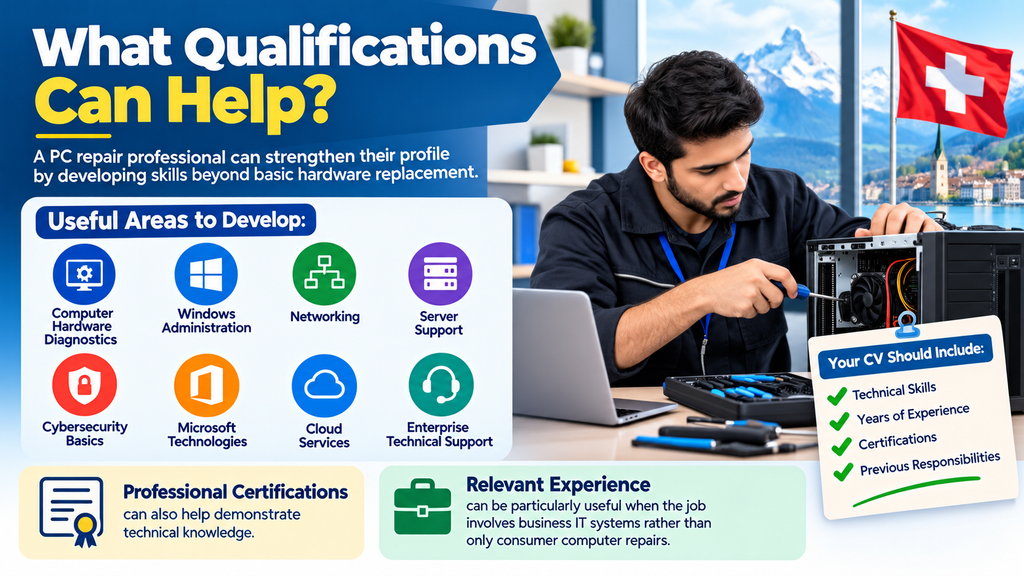
A PC repair professional can strengthen their profile by developing skills beyond basic hardware replacement.
Useful areas can include computer hardware diagnostics, Windows administration, networking, server support, cybersecurity basics, Microsoft technologies, cloud services and enterprise technical support.
Professional certifications can also help demonstrate technical knowledge.
Relevant experience can be particularly useful when the job involves business IT systems rather than only consumer computer repairs.
An applicant should clearly describe their technical skills, years of experience, certifications and previous responsibilities in their CV.
Education and Professional Experience
Swiss immigration authorities look at the qualifications and professional background of third-country workers.
The Swiss government states that non-EU/EFTA nationals generally need to be highly qualified, such as managers, specialists or other skilled professionals, with higher-education qualifications and professional experience in the relevant circumstances.
This does not mean that every computer-related job requires exactly the same educational background.
However, applicants should understand that a simple claim such as “I can repair computers” may not be enough for a third-country Swiss work permit.
A stronger application can include formal IT education, technical diplomas, certifications, several years of professional experience and specialised skills that match the employer’s requirements.
Skills for PC Repair and IT Support Jobs
Applicants can improve their employability by building practical skills.
Important areas may include:
Computer Hardware
A technician should understand computer components such as motherboards, processors, RAM, storage devices, power supplies and cooling systems.
Hardware diagnosis is important because technicians need to identify whether a problem is caused by a component, configuration or software issue.
Operating Systems
Experience with Windows is useful for many support roles.
Knowledge of Linux or macOS can also be valuable depending on the employer.
Networking
Basic networking knowledge can open additional opportunities.
Applicants can learn about IP addresses, routers, switches, Wi-Fi, DNS, DHCP and troubleshooting.
IT Support
Help-desk and desktop-support experience can be useful because many businesses need technicians who can troubleshoot employee computers and workplace technology.
Cybersecurity
Basic security knowledge can strengthen an IT support profile.
Understanding endpoint security, account protection, access controls, malware prevention and secure troubleshooting can be useful in modern IT environments.
Related Jobs to Search in Switzerland
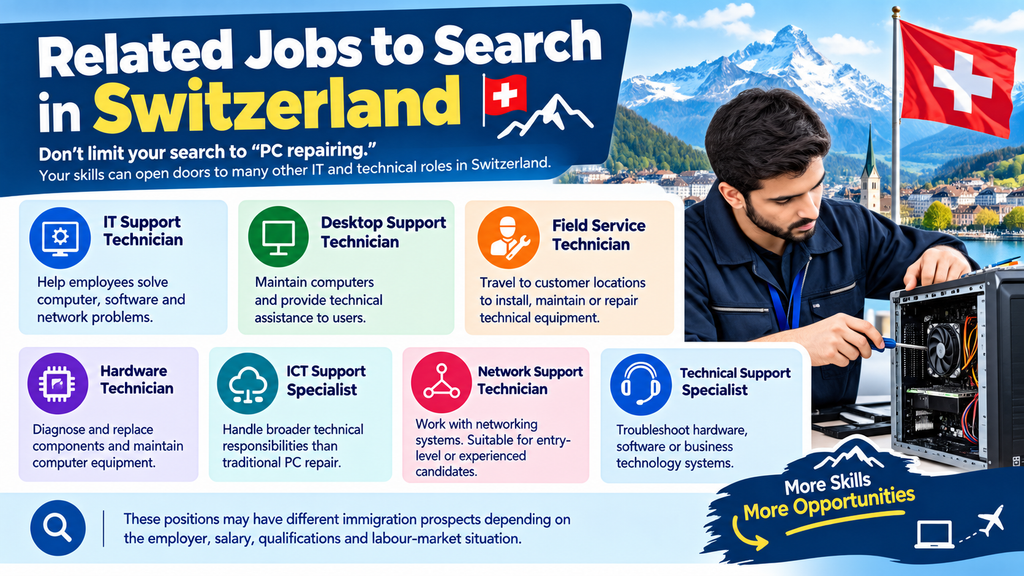
Someone with PC repair experience should not limit their search to the phrase “PC repairing.”
A wider search can include:
IT Support Technician
This role may involve helping employees solve computer, software and network problems.
Desktop Support Technician
Desktop support professionals maintain computers and provide technical assistance to users.
Field Service Technician
Field technicians may travel to customer locations to install, maintain or repair technical equipment.
Hardware Technician
Hardware technicians may diagnose and replace components and maintain computer equipment.
ICT Support Specialist
ICT support positions can involve broader technical responsibilities than traditional PC repair.
Network Support Technician
Candidates with networking knowledge can search for entry-level or experienced network support positions depending on their qualifications.
Technical Support Specialist
Technical support jobs can involve troubleshooting hardware, software or business technology systems.
These positions may have different immigration prospects depending on the employer, salary, qualifications and labour-market situation.
Swiss Work Permit Sponsorship Process
For a non-EU/EFTA applicant, the process generally starts with obtaining a genuine job offer from a Swiss employer.
The employer then submits the work-permit application to the relevant cantonal authority.
The Swiss authorities review whether the applicable admission requirements are met.
According to Switzerland’s State Secretariat for Migration, a non-EU/EFTA applicant needs a firm job offer first. The employer submits the work-permit application to the competent cantonal authority, after which the application can be forwarded for federal approval where required.
The applicant normally cannot simply apply for a Swiss work permit independently without an eligible employment arrangement.
Employer’s Role in Sponsorship
The employer has an important role in the Swiss immigration process.
The employer generally needs to demonstrate the reason for hiring the foreign worker and provide information about the position.
The application can require evidence concerning recruitment efforts and the availability of workers in Switzerland and the EU/EFTA area.
Swiss authorities can also examine salary and employment conditions.
The employment contract must meet the applicable regional, professional and sectoral conditions.
Therefore, when a job advertisement says that visa sponsorship may be available, applicants should still understand that the final work authorisation depends on approval by the relevant authorities.
2026 Swiss Work Permit Quota
Switzerland maintained its third-country worker quotas for 2026.
A maximum of 8,500 qualified workers and specialists from third countries can be recruited during 2026.
This includes 4,500 residence permits and 4,000 short-stay permits.
The quota is one reason why employers and immigration authorities carefully evaluate applications.
The existence of a quota does not mean every applicant has a guaranteed place. Other admission requirements must also be satisfied.
Salary and Employment Conditions
The salary offered to a foreign worker must comply with the applicable conditions.
Swiss authorities check whether the salary and employment conditions correspond to local, professional and sectoral standards.
This is important for international applicants because a company cannot simply offer an unusually low salary to a foreign worker and expect the work permit to be automatically approved.
The appropriate salary can depend on the profession, experience, canton, company and employment conditions.
Applicants should therefore research the normal salary range for the specific IT or technical position rather than relying on a single nationwide figure.
Documents for a Swiss Work Permit
The employer and applicant may need several documents during the work-permit process.
The Swiss authorities list documents such as a passport copy, CV, proof of qualifications, references and employment documentation among the required material for relevant applications.
A strong application may therefore include:
- Valid passport
- Updated CV
- Education certificates
- IT or technical certifications
- Employment references
- Experience letters
- Job offer or employment contract
- Job description
- Salary information
- Other documents requested by the canton
Documents may need certified translations when they are not in one of Switzerland’s official languages or English.
Applying for Jobs From Pakistan
Applicants living in Pakistan can search for Swiss employers before travelling.
This is generally the practical approach because a non-EU/EFTA applicant needs a firm Swiss job offer before the work-permit process can begin.
A candidate can prepare a professional CV and search Swiss companies for suitable technical vacancies.
When applying, the CV should clearly explain:
- Technical experience
- Computer hardware skills
- Software knowledge
- Networking experience
- Certifications
- Previous employers
- Years of experience
- Languages
- Education
The applicant should avoid making unsupported statements such as “I qualify for a Swiss visa” unless the actual immigration requirements have been checked.
Language Skills in Switzerland
Language can be important for technical jobs.
Switzerland has several national languages and the required language can depend on the location and the employer.
German is widely used in many parts of the Switzerland, while French and Italian are important in other regions.
English can be useful in international companies, particularly in some technology environments but it should not automatically be considered sufficient for every job.
A candidate applying for customer facing IT support may have the better employment prospects if they can communicate in the language commonly used at the workplace.
Where to Search for Swiss IT Jobs
International candidates can search company career pages and reputable employment platforms for Swiss technical positions.
Useful search terms include:
“IT Support Technician Switzerland”
“Computer Technician Switzerland”
“Hardware Technician Switzerland”
“Desktop Support Switzerland”
“Field Service Technician Switzerland”
“ICT Support Switzerland”
“Technical Support Switzerland”
“IT Service Technician Switzerland”
Candidates should read the complete job description and check whether the employer is the open to international candidates.
A job advertisement that does not mention sponsorship should not automatically be treated as a sponsored position.
Also read:Assistant Hotel Manager Jobs 2026 in New Zealand with Great Visa Sponsorship
How to Make Your CV Stronger
A good technical CV should be clear and focused.
Instead of writing only “PC repairing,” describe the actual work performed.
For example an applicant could explain experience with diagnosing hardware failures replacing components installing operating systems, troubleshooting networks configuring workstations and the providing technical support.
Professional achievements can also help.
If a technician managed a large number of company computers, reduced repair time or supported a business network, those responsibilities can demonstrate practical value.
The CV should always remain truthful.
Can Fresh Candidates Get Sponsorship?
Fresh candidates may find it more difficult to qualify for Swiss sponsorship from outside the EU/EFTA area.
Switzerland’s third-country admission system focuses on the highly qualified workers and specialists so professional experience can be particularly important.
Someone with no professional experience and only basic computer repair knowledge may face more difficulty than an experienced IT professional with specialised technical skills.
A practical long-term strategy can therefore be to gain professional experience, obtain relevant certifications and develop specialised IT skills before targeting international sponsorship opportunities.
PC Repair vs IT Support Career Path
A person interested in Switzerland can consider developing a broader IT career.
PC repair can be the starting point.
With additional training, a technician may move toward desktop support, network support, systems administration, infrastructure support or other specialised technical roles.
This can create a stronger professional profile than the remaining limited to basic computer repairs.
The exact career path depends on education, experience and the skills required by employers.
Avoid Fake Swiss Job Offers
International job seekers should be careful with the online offers claiming to the provide guaranteed Swiss sponsorship.
A genuine employer should provide clear information about the company, position, salary and employment conditions.
Applicants should never send money to someone simply because they promise a guaranteed Swiss work permit.
A work permit is not guaranteed merely because an applicant has paid a recruitment fee.
The Swiss Embassy in Pakistan states that employment in Switzerland requires the relevant authorisations and that the Swiss employer generally takes the necessary steps with the competent Swiss authorities. An entry visa is issued only after the required authorisations have been granted.
Step-by-Step Plan for 2026 Applicants
A practical plan can make the process easier.
First, build strong PC repair and IT support skills.
Second, gain professional experience and collect employment references.
Third, improve your CV and the clearly describe your technical responsibilities.
Fourth, obtain relevant certifications where they genuinely improve your professional profile.
Fifth, search Swiss employers for suitable IT and the technical vacancies.
Sixth, apply directly through legitimate company websites or the reputable employment platforms.
Seventh, if an employer decides to hire you, the employer can begin the relevant work-permit process.
Finally, after the required Swiss authorisations are granted, follow the visa and entry procedures applicable to your nationality.
Final Thoughts
PC repairing can be a useful technical career, but applicants from outside the EU/EFTA should understand that Switzerland has strict rules for third-country employment.
A basic PC repair position should not be presented as an easy visa-sponsorship route. Switzerland generally focuses third-country recruitment on highly qualified workers, specialists and other skilled professionals, and employers must satisfy labour-market and employment conditions.
For someone interested in Switzerland, expanding from basic PC repair into IT support, hardware support, networking, infrastructure or other specialised technical areas may create a broader range of jobs to search.
The most important step is to find a genuine Swiss employer that is willing to hire an international candidate and go through the required work-permit process.
There is no guaranteed visa or guaranteed sponsorship but the applicants with strong qualifications, relevant experience and a specialised technical profile can research the Swiss market and the apply for suitable opportunities in 2026.
1 thought on “PC Repairing Jobs in Switzerland 2026: Visa Sponsorship Guide”