Finding a job in Finland can be an attractive option for foreign workers who want to build an international career in Europe. Finland is known for its strong public services, modern economy, technology sector and demand for skilled professionals in several industries.
For workers outside Finland, one of the most important parts of the process is obtaining the correct residence permit for employment. In many cases, a foreign worker needs a confirmed job before applying for a residence permit based on employment.
People often use the term Finland visa sponsorship jobs when searching for Finnish employers willing to hire workers from abroad. However, Finland’s immigration system is generally based on residence permits rather than a simple sponsorship system where an employer automatically guarantees a visa.
For an employed person residence permit, the worker must have confirmed employment and the employer must provide the required employment information to the Finnish Immigration Service. The applicant must also meet the applicable salary, qualification and other requirements.
This complete guide explains Finland visa sponsorship jobs in 2026, possible job sectors, salary requirements, employer responsibilities, application steps, documents and important points foreign workers should know before applying.
What Are Finland Visa Sponsorship Jobs?
The phrase visa sponsorship jobs is commonly used by international job seekers to describe jobs where an employer is willing to hire a foreign worker and support the employment-related immigration process.
In Finland, the relevant process usually involves a residence permit based on employment.
For the standard residence permit for an employed person, the applicant must already have a confirmed job before applying. The employer then provides the terms of employment and other required information to the Finnish Immigration Service.
This means that finding a genuine Finnish job offer is one of the most important steps.
An employer cannot simply promise that a foreign worker will receive a visa. The worker must still meet Finnish immigration requirements and receive the appropriate residence permit before starting work.
Why Are Foreign Workers Looking for Jobs in Finland?
Finland has an advanced economy with employment opportunities across technology healthcare, engineering, manufacturing, construction logistics hospitality and the other industries.
International workers may be particularly interested in Finland because of its demand for specialized skills and the its growing international business environment.
However, the availability of jobs changes according to the occupation, region and economic situation.
Foreign workers should therefore focus on jobs that match their actual education, professional experience and skills rather than applying randomly to every vacancy.
Which Jobs May Offer Opportunities for Foreign Workers?
There is no single list of jobs that automatically receive sponsorship in Finland.
Employment opportunities depend on the employer, occupation, salary, qualifications and applicable residence permit route.
Several sectors can nevertheless be relevant for international applicants.
Technology and IT Jobs
Finland has an established technology sector and international companies operating in software, telecommunications, digital services, gaming and other technology fields.
Possible positions can include software developers, programmers, cloud specialists cybersecurity professionals data specialists and IT engineers.
Applicants with professional experience and the strong technical skills may find opportunities with companies that operate in English.
However, each employer decides whether it is willing to recruit from outside Finland.
Engineering Jobs
Engineering is another important area for international recruitment.
Potential positions can include mechanical engineers, electrical engineers, civil engineers, automation engineers, environmental engineers and industrial engineers.
Applicants should carefully check whether their profession is regulated and whether professional recognition or additional authorization is required.
Healthcare Jobs
Healthcare can also provide employment opportunities for foreign workers.
Doctors, nurses, healthcare professionals and other specialists may find opportunities depending on Finnish licensing and qualification requirements.
Healthcare is different from many other industries because professional authorization can be essential.
Having a foreign qualification does not automatically mean that a person can begin working in a regulated healthcare profession in Finland.
Construction Jobs
Construction companies may recruit workers for skilled positions depending on regional demand.
Examples can include construction workers, electricians, plumbers, welders, technicians, supervisors and other skilled trades.
Practical experience and vocational qualifications can be important for these positions.
Applicants should also check whether their specific occupation has licensing or certification requirements.
Manufacturing Jobs
Finland has manufacturing and industrial companies working in areas such as machinery, electronics, energy, forestry products and industrial technology.
Possible opportunities may include machine operators, maintenance technicians, production workers, engineers and industrial specialists.
For technical jobs employers may place strong importance on practical skills and previous industry experience.
Logistics and Transport Jobs
The logistics industry can also provide employment opportunities in the Finland.
Potential roles include warehouse workers logistics coordinators drivers mechanics and supply-chain professionals.
Driving positions may have additional requirements because commercial driving licences and qualifications can be subject to Finnish or European rules.
Hospitality and Restaurant Jobs
Hotels, restaurants and tourism businesses can recruit international workers for some positions.
Possible jobs include cooks, chefs, kitchen staff, hotel workers, cleaners and hospitality professionals.
However, sponsorship should never be assumed simply because a job is available.
The employer must be willing and legally able to employ a foreign worker and the applicant must qualify for the relevant residence permit.
Finland Residence Permit for an Employed Person
The standard residence permit for many foreign employees is the residence permit for an employed person, commonly referred to as the TTOL permit.
The Finnish Immigration Service states that applicants using this route must have confirmed employment before applying.
The permit is granted for the field of employment connected to the job for which the permit was issued.
The employer also has an important role in the process.
After the worker submits the application, the employer must provide the terms of employment through the relevant Finnish online service or the required paper form.
The employer must also verify that the worker has the professional skills required for the position.
Finland Salary Requirement 2026
Salary is an important part of the Finnish work residence permit process.
For a residence permit for an employed person, the worker’s total gross salary must be at least €1,600 per month in 2026.
The salary must also meet the minimum level specified in the applicable collective agreement where one applies.
The €1,600 figure is therefore not necessarily the normal salary for every occupation. Many professional jobs can require significantly higher salaries based on the position and collective agreement.
Salary supplements such as evening and night-work supplements are excluded from the €1,600 salary calculation.
The Finnish Immigration Service also states that zero-hours and on-demand employment contracts do not meet the requirements for this residence permit because the employer has not agreed to regular minimum working hours.
Higher Salary for Specialists
Foreign professionals applying as specialists have a different income requirement.
In 2026, the gross salary requirement for the specialist residence permit is at least €3,937 per month.
The same €3,937 monthly figure applies to applicants for an EU Blue Card in Finland in 2026.
This makes the specialist and EU Blue Card routes particularly relevant for highly qualified professionals with suitable employment offers.
Applicants should select the residence permit category that actually matches their employment and qualifications rather than choosing a route simply because its name sounds more attractive.
Also Read:Front of House Staff Jobs 2026 in Australia: Visa Sponsorship best Opportunity
Does Finland Require a Labour Market Test?
Some applications for an employed person’s residence permit can be subject to a labour market test.
Under this process, the employer may need to establish whether suitable labour is available within Finland or the EU/EEA for the position.
This means that foreign applicants should not assume that every Finnish job can automatically be filled by a worker from outside the EU.
The applicable assessment depends on the job and immigration rules in force at the time of application.
Does Finland Require IELTS?
IELTS is not a universal requirement for every Finnish work residence permit.
Language requirements depend on the job, employer and professional field.
Some international companies operate in English and may not require Finnish language skills for certain positions.
On the other hand, customer-facing jobs and the many local workplaces may require Finnish or Swedish.
Healthcare and regulated professions can also have separate language and professional requirements.
Applicants should therefore check the language requirements in the actual job advertisement rather than the assuming that English or IELTS is required for every position.
Step-by-Step Finland Visa Sponsorship Process
The process can be easier to understand when divided into several stages.
Step 1: Identify Your Target Occupation
Start by identifying the type of job you can realistically perform.
Consider your education professional experience certificates and the technical skills.
Your chances can improve when your background closely matches the employer’s requirements.
Step 2: Search for Finnish Employers
Search for genuine vacancies through company career pages and the reliable employment platforms.
International companies can sometimes advertise positions in English.
Read the complete job description and check whether is the company accepts applications from candidates who are currently outside Finland.
Step 3: Apply for the Job
Prepare a professional CV that clearly shows your education, work experience, technical skills and achievements.
Avoid adding qualifications or experience that you cannot prove.
For international applications your CV should be easy for an employer to understand.
Step 4: Attend the Interview
If an employer is interested, you may be invited to an online interview.
Prepare to explain your experience, responsibilities and the technical abilities.
You may also be asked why you want to work in Finland and whether you are prepared to relocate.
Step 5: Receive a Genuine Job Offer
If the employer selects you, you should receive information about the employment conditions.
Check the employer’s name, job title, salary, working hours, workplace and other contract terms carefully.
Step 6: Apply for the Residence Permit
Once you have confirmed employment, you can apply for the relevant residence permit.
For the standard employed-person permit, the Finnish Immigration Service requires the applicant to have a confirmed job before applying.
The first residence permit application is normally submitted from outside Finland.
Step 7: Employer Completes Its Part
After the worker submits the application, the employer provides the required terms of employment and supporting information.
The employer can use Enter Finland for Employers to submit the information electronically.
Submitting the employment information promptly can help the Finnish Immigration Service process is the application more efficiently.
Step 8: Prove Your Identity
The applicant may need to visit a Finnish mission or another designated service point to prove their identity and the provide biometric information as required.
Applicants should follow the instructions provided with their application.
Step 9: Wait for the Decision
The Finnish Immigration Service processes the application and checks whether the requirements have been met.
Processing time can vary depending on the application and whether additional information is required.
According to Migri’s published July 2026 statistics, positive first residence permit applications for the employed persons had an average processing time of 17 days from submission although individual cases can take longer.
Applicants should not treat an average processing time as a guarantee for their own case.
Step 10: Travel to Finland
Once the residence permit has been granted, the applicant can travel according to the conditions of the permit.
A person applying for a first residence permit for employment cannot start working before receiving the required residence permit.
Finland D Visa for Foreign Workers
Some foreign workers may also be able to apply for a D visa together with their residence permit application.
This can be available when the employer has obtained employer certification.
The D visa can allow an eligible worker to travel to Finland soon after the residence permit and D visa requirements have been completed.
The D visa is not a replacement for the residence permit. It is connected to the immigration process and is available only in situations where the relevant conditions are met.
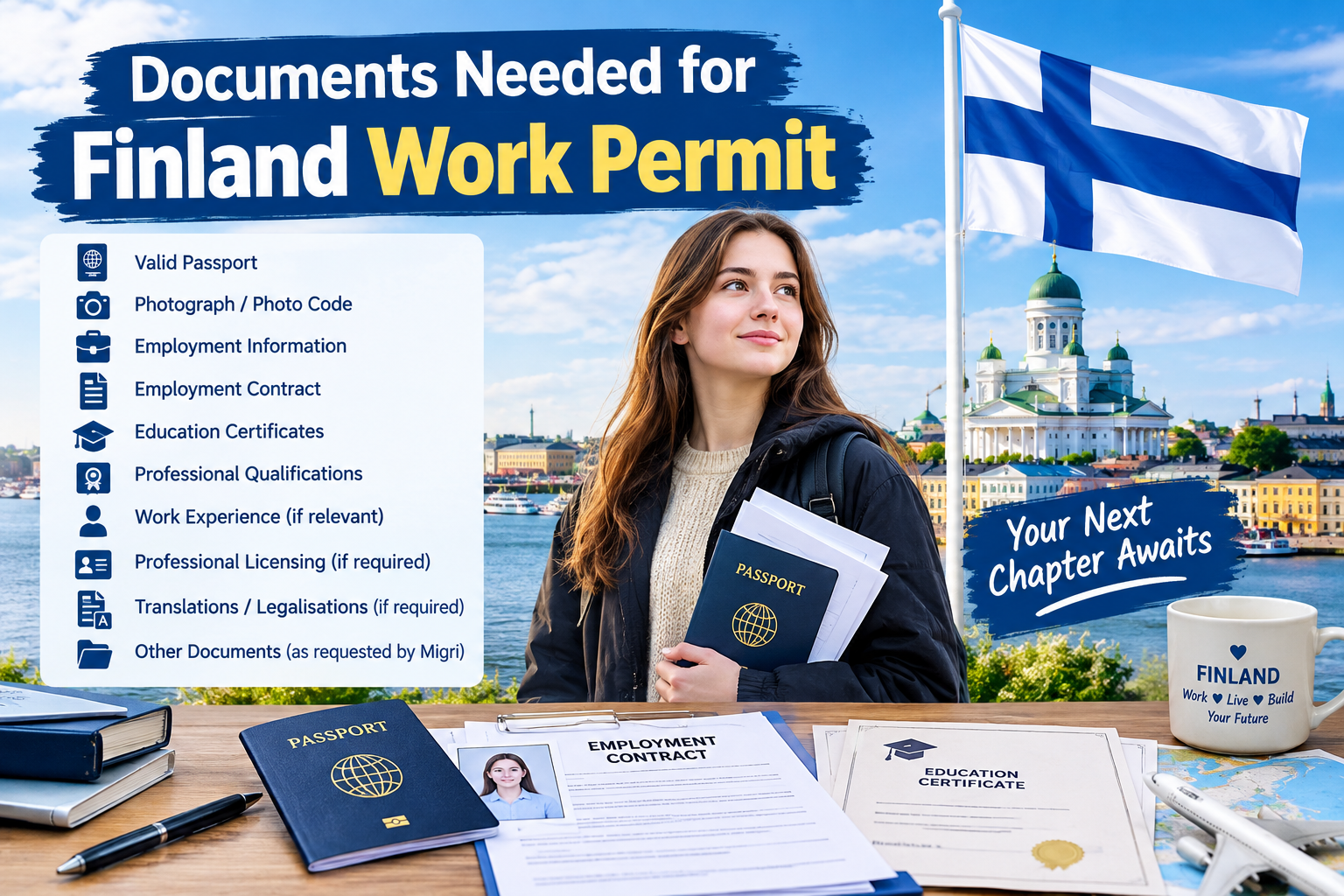
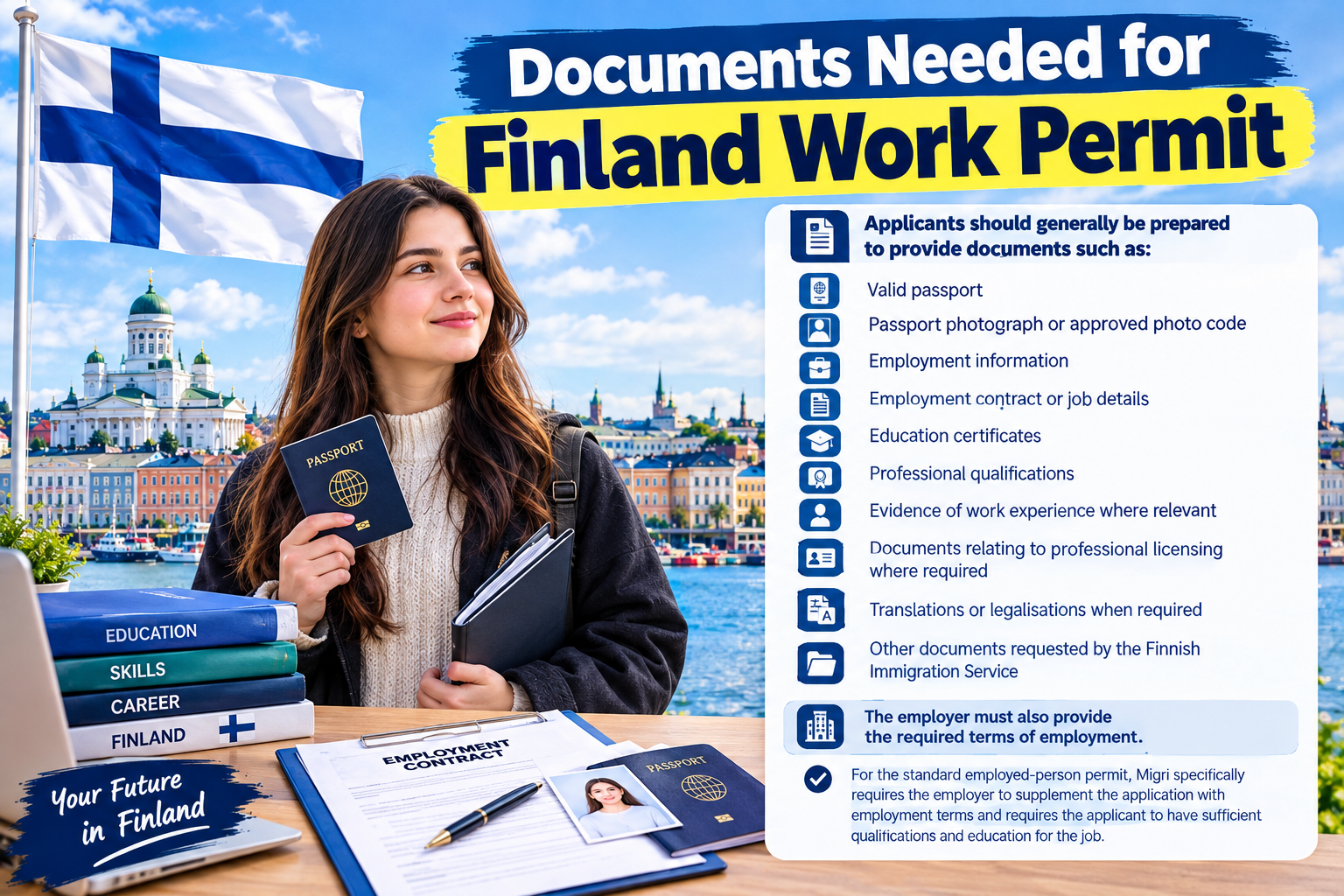
Documents Needed for Finland Work Permit
The exact documents depend on the residence permit and job.
Applicants should generally be prepared to provide documents such as:
Valid passport Passport photograph or approved photo code Employment information Employment contract or job details Education certificates Professional qualifications Evidence of work experience where relevant Documents relating to professional licensing where required Translations or legalisations when required Other documents requested by the Finnish Immigration Service
The employer must also provide the required terms of employment.
For the standard employed-person permit, Migri specifically requires the employer to supplement the application with employment terms and requires the applicant to have sufficient qualifications and education for the job.

Can Foreign Workers Bring Their Families?
Foreign workers who receive a residence permit in Finland may have family reunification options depending on their residence status and the circumstances of their family members.
A spouse or child may need to apply for their own residence permit based on family ties.
Family members should not assume that their applications are automatically approved simply because the main applicant has received a work permit.
The family member must meet the applicable requirements for their own residence permit.
Can a Finland Work Permit Lead to Permanent Residence?
A temporary work residence permit can be part of a longer immigration journey, but permanent residence is the not automatic.
Finland introduced updated permanent residence rules in 2026, including different application paths with the requirements relating to residence work history language skills and the other conditions.
For example, one permanent residence path requires six years of residence with a continuous permit, at least two years of work history in Finland and satisfactory Finnish or Swedish language skills at B1 level.
This means foreign workers should view permanent residence as a separate stage with its own requirements.
How to Improve Your Chances of Getting a Sponsored Job
The best way to improve your chances is to focus on jobs that genuinely match your qualifications.
A strong CV should clearly show your experience and technical skills.
If you are applying for an engineering, IT, healthcare or skilled-trade position, highlight the exact tools, technologies, certifications and responsibilities relevant to that occupation.
Language skills can also help.
Even when a particular company works mainly in English, learning Finnish can be useful for daily life and for future employment opportunities.
Professional qualifications should also be kept ready in digital form.
If your profession requires Finnish authorization, research the recognition and licensing process before applying for jobs.
Common Mistakes to Avoid
One common mistake is believing that every Finnish employer offers visa sponsorship.
The employer must be willing to employ the foreign worker and complete the required employment information.
Another mistake is accepting a job that does not meet the relevant salary requirement.
For the standard employed-person permit, the 2026 minimum gross salary is €1,600 per month, but the applicable collective agreement can require a higher salary.
Applicants should also avoid using fake employment documents or exaggerating their qualifications.
Another serious mistake is paying large amounts of money to an unknown person in exchange for a supposed guaranteed Finnish job or residence permit.
Always verify the employer and the vacancy before making financial commitments.
Beware of Fake Finland Visa Sponsorship Jobs
International job seekers should be careful with online advertisements promising guaranteed Finnish employment.
A fake recruiter may use a real company name, copied logo or fake employment contract to make the offer appear legitimate.
Warning signs can include requests for large upfront payments, pressure to send money quickly, promises of guaranteed visa approval or refusal to provide verifiable employer information.
A genuine job search should focus on the actual employer, position, employment terms and official immigration process.
Remember that an employer can support an employment process, but the final residence permit decision belongs to the Finnish immigration authorities.
Finland Jobs 2026: Who Should Apply?
Finland can be worth considering for foreign workers with useful professional skills, recognized qualifications and relevant experience.
IT professionals, engineers, healthcare workers, technical specialists, skilled tradespeople and other qualified workers may find opportunities depending on current recruitment demand.
However, applicants should not choose Finland simply because they have seen a social media post about “easy visa sponsorship.”
The right approach is to first identify a suitable occupation, then find genuine vacancies and finally check the residence permit requirements.
Final Thoughts
Finland Visa Sponsorship Jobs 2026 can be a realistic employment pathway for qualified foreign workers who find genuine Finnish employers and meet the requirements of the appropriate residence permit.
For the standard residence permit for an employed person, confirmed employment is required before applying. The employer must also provide the terms of employment, while the worker must have the required qualifications and sufficient income.
In 2026, the standard minimum gross salary for this permit is €1,600 per month, while specialist and EU Blue Card routes have a higher €3,937 monthly salary requirement.
The most important step is to focus on genuine employment rather than promises of guaranteed sponsorship.
Prepare a strong CV, apply for jobs that match your skills, verify employers carefully and check the latest Finnish Immigration Service requirements before submitting your residence permit application.
With realistic expectations and proper preparation, foreign workers can better understand the Finnish job market and the legal process for working in Finland in 2026.
2 thoughts on “Finland Visa Sponsorship Jobs 2026: Complete Guide for Foreign Workers”