
Uganda has a growing agriculture and agro-processing sector creating employment opportunities in food production grain processing manufacturing packaging and related industries. Flour mills are an important part of this sector because they process agricultural products such as maize millet wheat and other grains into products for local and regional markets.
For international workers flour mill jobs in Uganda may include production machine operation maintenance quality control warehouse operations electrical work and technical supervision. However getting a job in Uganda from another country involves more than finding a vacancy.
Foreign workers need the appropriate immigration permission to live and work legally in Uganda. Uganda’s immigration authority states that work permits allow foreign applicants to live and work in the country and that the permit is sponsored by an organisation or company with the required organisation code.
This guide explains flour mill jobs in Uganda in 2026 possible positions qualifications employer sponsorship and the general work-permit process for international applicants.
Flour Mill Jobs in Uganda
A flour mill is a food-processing facility where grains and other agricultural products are cleaned processed milled and packaged.
The exact jobs available depend on the size and type of mill.
Common positions can include:
- Flour Mill Machine Operator
- Milling Machine Technician
- Production Worker
- Production Supervisor
- Maintenance Technician
- Mechanical Technician
- Electrical Technician
- Quality Control Assistant
- Food Processing Technician
- Packaging Machine Operator
- Warehouse Worker
- Storekeeper
- Forklift Operator
- Production Manager
- Mill Maintenance Supervisor
Not every position will be available to foreign workers. Employers generally recruit locally for many routine positions while international recruitment is more likely to be relevant for specialised technical or managerial roles.
Is Visa Sponsorship Available for Flour Mill Jobs in Uganda?
Uganda does have an employer-sponsored work-permit system for foreign workers.
The Directorate of Citizenship and Immigration Control states that a work permit allows a foreign national to live and work in Uganda and that the permit is sponsored by an organisation or company.
This means an international applicant normally needs a genuine Ugandan employer before the work-permit process can be completed.
However a job advertisement should not automatically be interpreted as a guaranteed sponsored position.
The employer must be willing and able to support the appropriate work-permit application and the applicant must meet the requirements for the relevant permit category.
Uganda’s Agro-Processing Industry
Flour milling is connected to Uganda’s wider agricultural and agro-processing industry.
The Uganda Investment Authority identifies agro-industrialisation as an important investment area and highlights food processing and the agricultural value chains as the significant parts of the country’s industrial development.
Uganda produces crops including maize millet rice cassava and other agricultural products that they can support food-processing businesses.
The country’s investment authority has also identified millet flour processing as an investment opportunity showing the role that grain milling can play within Uganda’s agro-processing sector.
This creates a broader employment environment around milling packaging storage transportation maintenance and food production.
Types of Flour Mill Jobs
Flour Mill Machine Operator
Machine operators work with milling and processing equipment.
Their responsibilities can include starting and stopping machinery monitoring production checking equipment performance and reporting mechanical problems.
Experience with industrial machinery can be useful for these positions.
Milling Technician
A milling technician may have more technical responsibilities than a basic production worker.
The job can involve machine setup troubleshooting preventive maintenance and adjustments to processing equipment.
Applicants with mechanical or industrial technical experience may be suitable for these roles depending on the employer’s requirements.
Mechanical Maintenance Technician
Large processing facilities require regular maintenance of the machines and production systems.
Mechanical technicians can work on conveyors motors pumps bearings belts and other industrial equipment.
Experience in food-processing or manufacturing environments can strengthen an application.
Electrical Technician
Flour mills use electrical systems to operate machinery and production equipment.
Electrical technicians may be responsible for troubleshooting electrical faults maintaining control systems and the supporting production equipment.
Professional qualifications and any required local authorisation should be checked before accepting this type of work.
Production Supervisor
A production supervisor can oversee workers production schedules machinery and workplace procedures.
Employers may look for previous experience in manufacturing food processing or industrial production.
Supervisory positions are generally more specialised than entry-level production jobs.
Quality Control Worker
Quality control staff help monitor products and production processes.
In a flour mill this can involve checking raw materials monitoring processing conditions and inspecting finished products.
Food science food technology or laboratory experience may be useful for specialised quality roles.
Packaging Operator
Packaging workers operate or monitor equipment that fills seals labels and prepares flour products for distribution.
These positions may require machine-operation skills and knowledge of workplace safety.
Warehouse and Store Jobs
Flour mills also need workers for receiving raw materials storing finished products and preparing orders.
Jobs can include storekeeper warehouse assistant inventory clerk and logistics worker.
However routine warehouse positions may be more likely to be filled locally so international applicants should not assume that these jobs normally come with sponsorship.
Qualifications for Flour Mill Jobs
Requirements depend on the position.
Entry-level production roles may require basic education physical fitness safety awareness and previous factory experience.
Technical positions can require vocational training diplomas or professional qualifications.
For example a mechanical maintenance position may require mechanical engineering or the industrial maintenance training while an electrical technician may need electrical qualifications and relevant practical experience.
Supervisory and the managerial jobs generally require more professional experience.
Applicants should therefore match their qualifications to the exact vacancy rather than applying for every flour mill position with the same CV.
Experience Can Make a Difference
Experience is particularly useful for international applicants.
A person who has worked in a grain mill food-processing factory or manufacturing plant can demonstrate practical knowledge that may be relevant to an employer.
Useful experience can include operating industrial machinery preventive maintenance production monitoring quality control electrical troubleshooting and workplace safety.
Applicants should clearly describe this experience on their CV.
Instead of writing only “worked in flour mill” explain the machines used responsibilities performed and type of production environment.
Employer-Sponsored Work Permits in Uganda
Uganda’s immigration authority states that work permits are sponsored by organisations or companies.
This means the process normally starts with employment.
An international applicant should first obtain a genuine job offer from a Ugandan company.
The employer can then support the relevant immigration application.
The exact permit class depends on the applicant’s employment circumstances.
Uganda’s immigration system includes different entry-permit classes for different categories of foreign nationals. It also has Class G2 for expatriate employees and Class G3 for expatriates with rare skills employed in certain agro-processing manufacturing and mining activities.
The relevant category should therefore be confirmed with the Ugandan immigration authority and the employer before an applicant makes travel arrangements.
Class G3 and Specialised Agro-Processing Skills
Class G3 is particularly relevant when discussing specialised foreign workers in agro-processing.
Uganda’s immigration authority describes Class G3 as applying to expatriates with rare skills employed in agro-processing manufacturing and certain mining activities.
The listed requirements include a valid passport photograph police clearance appointment letter certified qualifications and proof of failure to employ a qualified Ugandan. The authority also lists an NCHE equivalence certificate among the requirements.
This does not mean that every flour mill worker qualifies for G3.
Rather it shows why specialised technical skills can be more relevant for international recruitment than ordinary entry-level factory work.

Employer’s Role
The employer has an important role in the work-permit process.
A company hiring a foreign worker may need to provide employment documentation and other information required by immigration authorities.
For specialised foreign workers under Class G3 Uganda’s immigration authority specifically lists an appointment letter qualifications and evidence concerning the availability of qualified Ugandan workers among the requirements.
Therefore applicants should understand that sponsorship is not simply a payment made by the worker.
The employer must participate in the legal employment and immigration process.
Documents International Applicants May Need
The exact document list depends on the work-permit category.
Common documents can include:
- Valid passport
- Passport-size photograph
- Job offer or appointment letter
- Employment contract where required
- CV
- Education certificates
- Technical qualifications
- Professional certificates
- Police clearance
- Evidence of work experience
- Other documents requested by immigration authorities
For Class G3 applications Uganda’s immigration authority specifically lists a passport photograph police clearance appointment letter certified qualifications and the other supporting documents.
Applicants should prepare genuine documents and should not submit altered certificates or false employment records.
Applying From Outside Uganda
International applicants can search for the jobs before travelling to Uganda.
A practical approach is to identify companies involved in flour milling grain processing food manufacturing and the agro processing.
Applicants can then check their official career pages and the reputable employment platforms for vacancies.
Search terms can include:
“Flour Mill Jobs Uganda”
“Mill Operator Jobs Uganda”
“Grain Milling Jobs Uganda”
“Food Processing Jobs Uganda”
“Mill Maintenance Technician Uganda”
“Production Technician Uganda”
“Mechanical Technician Flour Mill Uganda”
“Electrical Technician Food Processing Uganda”
“Production Supervisor Uganda”
Candidates should carefully read the job description before applying.
Building a Strong CV
A strong CV can help an applicant communicate technical experience clearly.
For a flour mill position the CV can mention:
- Years of industrial experience
- Machines operated
- Milling or processing experience
- Maintenance skills
- Electrical or mechanical knowledge
- Production responsibilities
- Food safety experience
- Quality control experience
- Workplace safety training
- Previous employers
- Professional qualifications
A technician should explain what equipment they have worked with instead of simply listing “machine maintenance.”
This gives an employer a better understanding of the applicant’s practical abilities.
Language Skills
English is widely used in Uganda’s official and business environment so good English can be useful for international workers.
Applicants should still check the language requirements of individual employers.
For technical positions being able to understand safety instructions maintenance manuals and workplace procedures is particularly important.
Good communication can also help workers coordinate with production teams and supervisors.
Also read:Bread Factory Worker Jobs 2026 in Poland Best Role with Visa Sponsorship
Salary Expectations
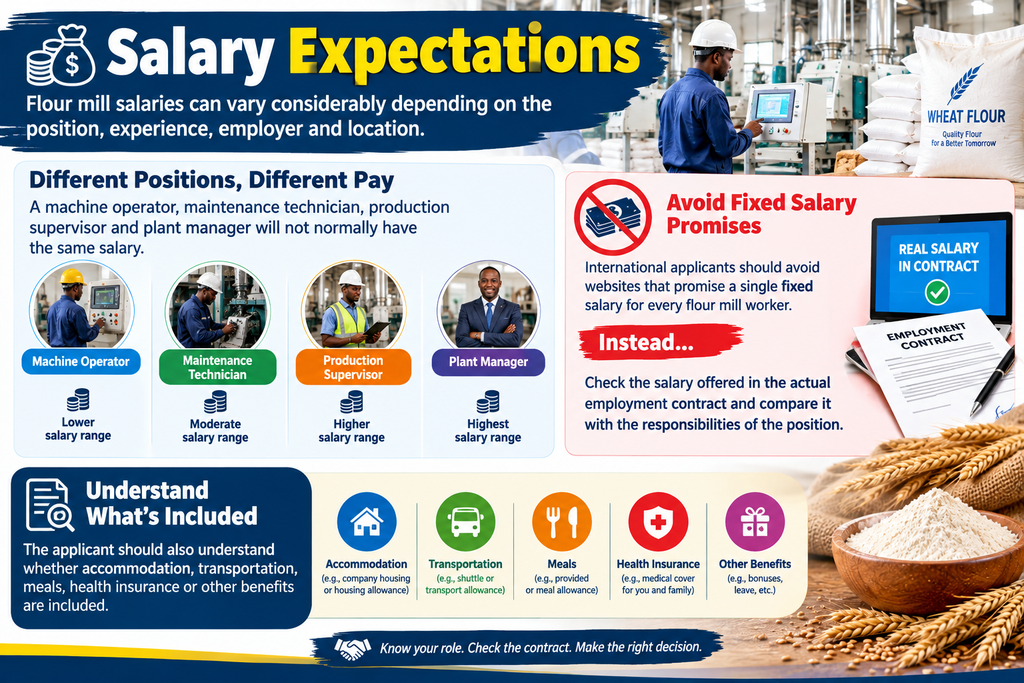
Flour mill salaries can vary considerably depending on the position experience employer and location.
A machine operator maintenance technician production supervisor and plant manager will not normally have the same salary.
International applicants should avoid websites that promise a single fixed salary for every flour mill worker.
Instead check the salary offered in the actual employment contract and compare it with the responsibilities of the position.
The applicant should also understand whether accommodation transportation meals health insurance or other benefits are included.
Benefits and Employment Conditions
Some employers may provide additional benefits as part of an employment package.
These can include accommodation transport medical insurance meals or other allowances.
However benefits are not automatically included in every job.
Applicants should read the employment contract carefully before accepting an offer.
The contract should clearly explain the position salary working hours benefits and other important conditions.
Who Has Better Opportunities?
For an international applicant specialised technical positions may be more relevant than basic factory jobs.
A person with experience in industrial machinery maintenance may have a different profile from someone who has only worked in general production.
Similarly an experienced electrical technician mechanical technician production supervisor or food-processing specialist may be able to demonstrate skills that are directly valuable to an employer.
This does not guarantee sponsorship but it can make the applicant’s professional profile more relevant to specialised vacancies.
Safety Skills for Flour Mill Workers
Safety is particularly important in industrial food-processing facilities.
Workers may operate heavy machinery conveyors motors and electrical equipment.
Applicants should understand workplace safety procedures and follow employer training.
Technical workers should also understand lockout and maintenance procedures relevant to the their responsibilities.
Food-processing workers may need additional training concerning hygiene and contamination prevention.
Flour Milling and Other Agro-Processing Jobs
Someone interested in flour mills can also search for related positions in Ugandas wider agroprocessing industry.
Possible areas include grain processing edible oils animal feed production food packaging agricultural machinery storage and logistics.
Uganda Investment Authority identifies agro-industrialisation as a major investment area and highlights food processing and agricultural value chains.
This means applicants can search beyond traditional flour mills when looking for relevant technical and production work.
Avoid Fake Visa Sponsorship Offers
International job seekers should be careful with online advertisements that promise guaranteed work permits.
A genuine employer should be able to provide clear information about the company job title salary work location and employment conditions.
Applicants should be suspicious if someone asks for a large payment in exchange for a guaranteed job or immigration approval.
Uganda’s work permit system involves sponsorship by an organisation or company so applicants should not assume that paying an individual guarantees a permit.
Never provide fake certificates fake experience letters or false information.
Step-by-Step Application Roadmap
A practical plan for an international applicant can look like this.
Step 1: Build relevant skills.
Develop experience in milling food processing industrial machinery mechanical maintenance electrical systems or production management.
Step 2: Prepare your CV.
Clearly describe your qualifications and practical experience.
Step 3: Search for genuine vacancies.
Look at flour mills grain-processing businesses food manufacturers and agro-processing companies.
Step 4: Apply directly.
Use company career pages or the reputable job platforms whenever possible.
Step 5: Receive a genuine job offer.
The employer should provide the position salary and the employment conditions in writing.
Step 6: Confirm work-permit sponsorship.
Ask the employer which Ugandan work-permit category applies to the position.
Step 7: Prepare immigration documents.
Provide the documents required for the applicable permit category.
Step 8: Wait for the required approval.
Do not begin employment in the Uganda until you have the legal permission required for the your situation.
Step 9: Travel after approval.
Once the required immigration authorisation and entry arrangements are complete follow the instructions provided by the relevant authorities.
Final Thoughts
Flour mill jobs can be part of Uganda’s wider agro-processing and manufacturing sector in 2026. The country has identified agro-industrialisation and food processing as important areas of economic development while grain and flour processing provide opportunities across production machinery maintenance quality control packaging and logistics.
For international workers however a flour mill job should not be presented as an automatic visa sponsorship opportunity.
Uganda requires foreign workers to obtain the appropriate immigration permission and work permits are sponsored by an organisation or company. Specialised foreign workers in certain agro-processing and manufacturing roles may fall under specific permit categories such as Class G3 when the relevant requirements are met.
Applicants should therefore focus on genuine employers relevant qualifications and practical experience.
A strong technical background in milling machinery mechanical maintenance electrical systems production supervision or food processing can provide a more specialised profile when applying for international positions.
Most importantly applicants should verify the job employer and work-permit requirements before paying money or making travel arrangements.