Canada continues to attract experienced transportation workers from different countries, and truck driving remains an important occupation in the Canadian economy. For foreign truck drivers however getting a job in Canada is not simply a matter of finding a vacancy and the receiving is a visa. The worker must meet the requirements for the job while the employer must follow the applicable rules for hiring a temporary foreign worker.
For many employer-specific truck driving positions, an employer may need a Labour Market Impact Assessment (LMIA) before the foreign worker can apply for a work permit. A positive LMIA indicates that there is a need for a temporary foreign worker and that the employer has met the requirements of the relevant program.
This guide explains how Canada truck driver jobs with possible LMIA support can work in 2026 what qualifications applicants may need, what the employer does and the what foreign drivers should understand before applying.
What Does LMIA Mean for Truck Driver Jobs?
A Labour Market Impact Assessment, commonly called an LMIA, is an assessment used by the Canadian government to determine the effect of hiring a temporary foreign worker on Canada’s labour market.
For an LMIA-required position, the Canadian employer — not the foreign worker — normally applies for the LMIA. A positive LMIA confirms that there is a need for the foreign worker and that Canadian citizens or permanent residents are not available to fill the position under the program’s requirements.
An LMIA is therefore not a visa and it does not automatically give a foreign driver the right to work in Canada.
After receiving the required employer documents, the foreign worker generally needs to apply for an employer-specific work permit. Canada describes this type of permit as a permit that allows a worker to work under the employer, location and occupation conditions listed on the permit.
This is why the phrase “visa sponsorship” should be understood carefully. In many job advertisements, sponsorship means that an employer is willing to consider hiring a foreign worker and, where required, supporting the immigration process. It does not mean that approval is guaranteed.
Are Truck Driver Jobs in Canada Available to Foreign Workers?
Yes, foreign workers can potentially work in Canada trucking industry when they meet the applicable immigration employment and the licensing requirements.
However, not every truck driver vacancy is open to applicants outside Canada. Some employers recruit only workers who already have Canadian work authorization, while others may consider international candidates when they are prepared to complete the required employer process.
Applicants should therefore look for vacancies that clearly explain whether the employer is considering foreign workers and whether LMIA support is available.
A job advertisement mentioning “LMIA” should also be checked carefully. The presence of the word LMIA in an advertisement does not by itself prove that an employer has already received a positive LMIA.
Truck Driver Qualifications in Canada
Truck driving is a regulated occupation, so applicants must pay close attention to provincial or territorial licensing requirements.
The exact licence required depends on the type of commercial vehicle, the province or territory where the driver will work, and the duties involved. A foreign commercial driving licence may demonstrate previous experience but it does not the automatically mean that the driver can operate is a Canadian commercial vehicle without meeting local requirements.
Applicants should therefore research the commercial driver licence requirements in the province where the employer is a located.
Driving Experience
Employers may look for previous commercial or the long haul driving experience, depending on the vacancy.
A strong application can include:
- Previous truck-driving employment
- Type of trucks operated
- Long-haul or regional driving experience
- Employment reference letters
- Driving records or abstracts where applicable
- Details of routes and responsibilities
- Relevant safety training
There is no single experience requirement that applies to every Canadian truck driver job. The employer’s vacancy and the applicable licensing rules determine what experience is needed.
Commercial Driver’s Licence
Canadian provinces and territories regulate commercial driving licences. The licence class and endorsements can vary according to the vehicle and type of driving.
For example, applicants may encounter requirements related to:
- Heavy commercial vehicles
- Tractor-trailer combinations
- Air-brake systems
- Dangerous goods
- Other commercial vehicle qualifications
A foreign driver should not assume that a licence from their home country can simply be exchanged for every Canadian commercial licence. The applicant should check the rules of the province or territory where they plan to work.
This is particularly important because immigration approval and driving authorization are separate matters.
Language Requirements
Truck drivers need enough English or French to understand workplace instructions, communicate safely and deal with customers, dispatchers, border officials and other road users.
However, applicants should be careful with general claims that every truck driver must achieve a particular IELTS or CLB score.
A specific language test score is not automatically a universal requirement for every truck driver job or every work permit application. Requirements can depend on the immigration program, employer, province, licensing process and future permanent-residence pathway.
If a job advertisement specifies language requirements, applicants should make sure they can meet them before applying.
Documents That Can Strengthen a Truck Driver Application
A foreign truck driver should prepare documents that demonstrate both professional experience and eligibility.
Common documents may include:
- Valid passport
- Updated résumé
- Employment reference letters
- Proof of previous driving experience
- Commercial driving licence
- Driving record or abstract, where available
- Training certificates
- Job offer or employment contract
- Positive LMIA documents, when required
- Proof of education, if requested
- Medical examination documents, if required
- Police certificates or other supporting documents, if requested
- Translations for documents that are not in English or French
For employer-specific work permit applications from outside Canada, IRCC states that applicants may need proof of the past work experience, such as pay records reference letters and proof that they meet the job requirements including a licence or the certification where the occupation requires one.
Also Read:Sweden Shopkeeper Jobs 2026: Visa Sponsorship Full Guide
How the LMIA and the Work Permit Process Works
The process normally involves both the Canadian employer and the foreign worker.
Step 1: Find a Suitable Truck Driver Vacancy
The first step is finding a genuine Canadian employer that is the recruiting truck drivers.
Applicants should read the vacancy carefully and check:
- Job title
- Location
- Type of driving
- Required licence
- Experience requirements
- Wage
- Work schedule
- Benefits, if offered
- Whether international applicants are considered
- Whether LMIA support is the mentioned
The Government of Canada Job Bank can also be used to the search for jobs, including opportunities relevant to the temporary foreign workers.
Applicants should never pay an individual simply because they promise an LMIA or guaranteed Canadian work permit.
Step 2: Employer Decides Whether an LMIA Is Required
The employer must determine whether the position requires an LMIA or qualifies for an exemption.
Most temporary foreign worker jobs require an LMIA unless an exemption applies.
For an LMIA-required truck driver position, the employer must follow the applicable Temporary Foreign Worker Program requirements.
The employer is responsible for the LMIA application. A foreign worker cannot apply for an LMIA on behalf of themselves.
Step 3: Employer Receives a Decision
If the employer receives a positive LMIA, the foreign worker can receive the documents needed for the next stage of the process.
For an LMIA-required work permit application, IRCC states that the worker generally needs documents such as the positive LMIA and file number, employment contract and job offer letter.
A positive LMIA does not itself equal a work permit.
Step 4: Apply for an Employer-Specific Work Permit
After receiving the necessary documents, the foreign worker can apply for an employer-specific work permit if eligible.
This type of work permit is connected to the conditions stated on the permit, including the employer and occupation.
The applicant must still satisfy the general requirements for a Canadian work permit. Immigration officers can request additional documents depending on the application.
Step 5: Medical Examination and Other Requirements
Some applicants may need a medical examination depending on the their circumstances and intended work.
Applicants may also be required to provide biometrics, police certificates or the other documents.
The exact checklist can differ according to the applicant situation and the where the application is submitted so applicants should follow the personalized instructions provided during the application process.
Step 6: Travel to Canada After Approval
A worker should not assume that receiving is a job offer means they can immediately travel to Canada and begin working.
The required immigration approval must be the obtained first.
When the worker arrives in Canada they must comply with the conditions of their work permit and the work according to the authorized employes occupation and other conditions.
Is LMIA the Same as Visa Sponsorship?
Not exactly.
“Visa sponsorship” is a common phrase used in job advertisements, but Canadian immigration uses more specific terms such as employer-specific work permits and LMIA.
For an LMIA-required position, the employer completes the LMIA process and provides the relevant documents to the worker. The worker then applies for the appropriate work permit.
The employer does not simply “give” the applicant a visa.
This distinction is important because a job offer, LMIA and work permit are separate stages of the process.
Can Truck Drivers Get Permanent Residence in Canada?
Truck driving experience can potentially be relevant to permanent-residence pathways, but there is no automatic rule that a truck driver becomes eligible for permanent residence after 12 months of work.
Eligibility depends on the immigration program, occupation classification, work experience, language ability, education, province, age, and other factors.
Some candidates may explore Express Entry or a provincial immigration pathway if they meet the requirements of that program.
Applicants should therefore avoid job advertisements or websites claiming that every foreign truck driver will automatically receive permanent residence after one year.
A Canadian job can be an important part of an immigration plan, but permanent residence requires a separate assessment under the applicable program.
Truck Driver Jobs and Express Entry
A qualifying job offer can sometimes play a role in an immigration application, but applicants should understand that employment and permanent residence are separate processes.
For Express Entry, the rules surrounding job offers, LMIA support and eligibility can change. Canada’s official information states that in most cases an employer needs an LMIA to support a job offer for Express Entry when an LMIA is required, although specific exceptions exist.
Applicants should therefore check the current Express Entry requirements before relying on a truck driver job as a permanent-residence strategy.
Provincial Opportunities for Truck Drivers
Truck drivers may also explore provincial immigration programs.
Different provinces have different labour-market needs and immigration streams. A trucking job in one province may have different immigration possibilities from a similar job in another province.
This means applicants should consider both the employment opportunity and the immigration rules of the province.
For example, someone interested in working in Ontario should examine Ontario’s current requirements, while someone considering Alberta, Saskatchewan, Manitoba or British Columbia should review the relevant provincial program separately.
Applicants should not assume that a job automatically qualifies for a provincial nomination simply because the occupation is in demand.
Salary and Employment Conditions
Truck driver wages vary according to employer, location, driving distance, experience, vehicle type, schedule and other employment conditions.
Some positions may offer hourly wages, while others may use different compensation arrangements.
Applicants should carefully review the employment contract before accepting a position.
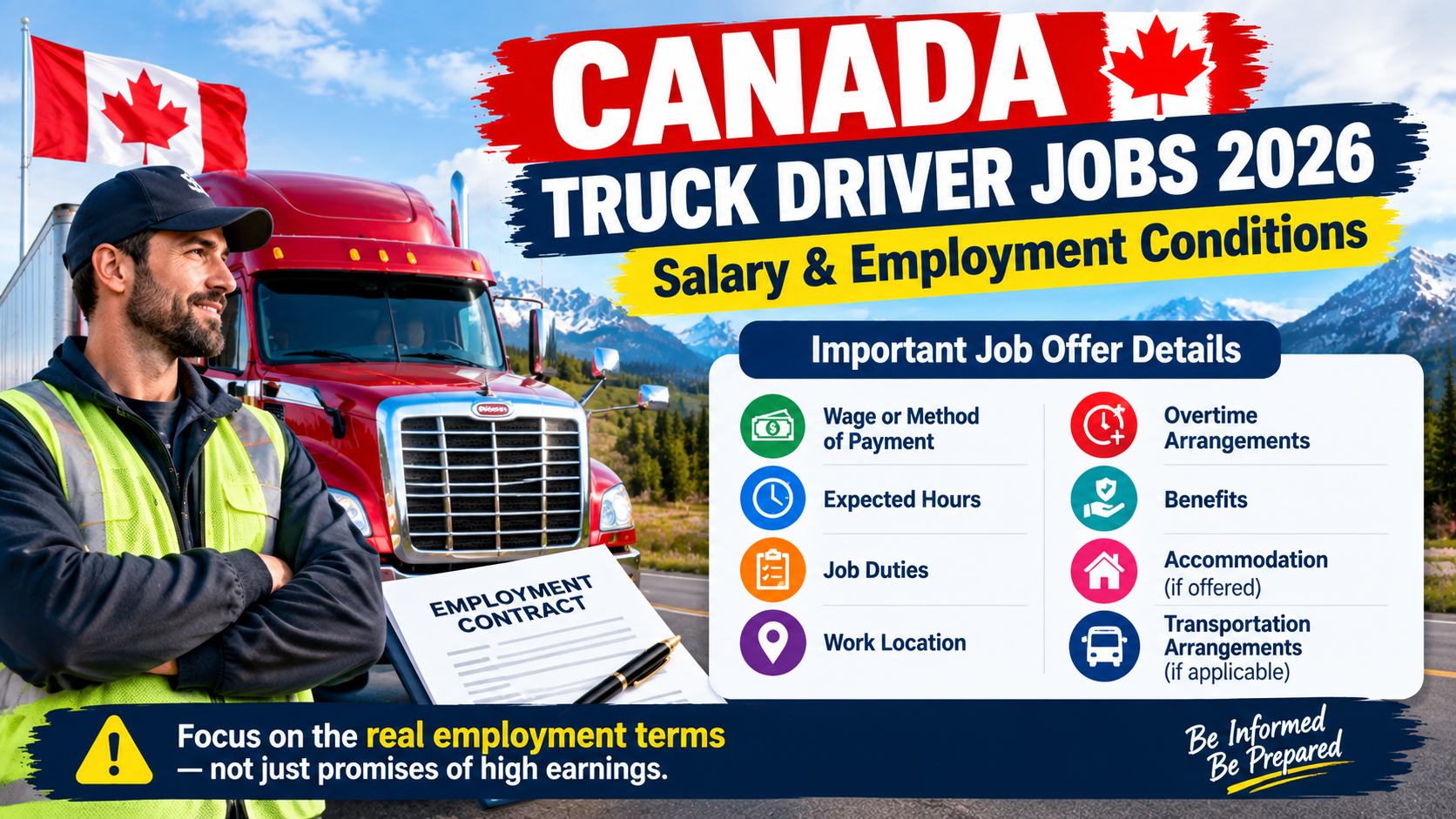
The job offer should clearly explain important details such as:
- Wage or method of payment
- Expected hours
- Job duties
- Work location
- Overtime arrangements
- Benefits
- Accommodation, if offered
- Transportation arrangements, if applicable
A professional application should focus on the actual employment terms rather than the promises of unusually high earnings.
Beware of Fake LMIA and Truck Driver Job Offers
Foreign workers should be especially careful with advertisements promising guaranteed LMIA approval, guaranteed work permits or guaranteed permanent residence.
A genuine Canadian employer should not require a worker to purchase an LMIA from them.
Canada’s official information makes clear that the LMIA process is an employer process. A temporary foreign worker cannot simply obtain an LMIA independently and use it to create their own truck-driving job.
Applicants should also be cautious when someone asks for large payments in exchange for a job offer.
Before sending money or personal documents, verify the employer, job advertisement and immigration information through reliable sources.
How to Find Truck Driver Jobs in Canada
Applicants can search through Canadian employment platforms and company career pages.
Useful approaches include searching for terms such as:
Truck Driver Jobs Canada 2026, Class 1 Truck Driver, AZ Truck Driver, Long Haul Truck Driver, Transport Truck Driver, Regional Truck Driver, Heavy Truck Driver and LMIA-supported Truck Driver Jobs.
However, the keyword “LMIA” should not be treated as proof that sponsorship is available.
Always read the complete vacancy and confirm directly with the employer whether they are accepting international applicants and whether they are prepared to complete the required process.
Tips for Foreign Truck Drivers Applying From Abroad
A strong application should be professional and easy for the employer to understand.
Your résumé should clearly show your commercial driving history rather than simply saying that you are an experienced driver.
Include the types of vehicles you have driven, years of experience, major routes, safety record, licence details and relevant training.
If you have worked for several transportation companies, include accurate employment dates and reference information where available.
It is also useful to prepare scanned copies of important documents in advance, but do not send sensitive personal documents to unknown recruiters.
Frequently Asked Questions
Can a foreign truck driver get an LMIA job in Canada?
A foreign truck driver may be hired through an LMIA-supported position when a Canadian employer meets the applicable requirements and receives a positive LMIA. The worker must then separately qualify for and obtain the appropriate work permit.
Does every Canadian truck driver job offer LMIA sponsorship?
No. Some employers recruit only workers who already have Canadian work authorization. Applicants should confirm whether a specific employer is willing to consider international candidates and whether an LMIA is required.
Do I need a Canadian truck licence?
Commercial driving is regulated at the provincial or territorial level. Foreign drivers may need to obtain or qualify for the appropriate Canadian commercial licence before performing certain driving duties.
Is IELTS mandatory for every truck driver?
Not necessarily. A specific IELTS score is not a universal requirement for every truck driver position. Language requirements depend on the job, licensing rules and immigration pathway.
Does one year of truck driving automatically give permanent residence?
No. One year of Canadian work experience does not automatically result in permanent residence. The applicant must qualify under a specific immigration program and meet all of its requirements.
Who applies for the LMIA?
For an LMIA-required position, the Canadian employer applies for the LMIA. The foreign worker does not independently obtain an LMIA for themselves.
Is a positive LMIA the same as a work permit?
No. A positive LMIA supports the employer’s hiring process, while the foreign worker must separately apply for the appropriate work permit and meet the immigration requirements.
Final Thoughts
Canada truck driver jobs can provide opportunities for qualified foreign drivers, but the process is more complicated than simply finding an advertisement that says “visa sponsorship available.”
For an LMIA-required position, the Canadian employer normally has to complete the LMIA process before the worker can apply for the related employer-specific work permit. The applicant must also meet the requirements for the job, immigration process and commercial driving authorization.
There is also no guarantee that every truck driver will receive an LMIA, work permit or permanent residence. Requirements can vary according to the employer, province, immigration program and individual applicant.
The safest approach is to find a genuine employer, verify the job details, understand the licensing requirements, follow the official work-permit process and avoid anyone promising guaranteed immigration results.
For 2026 applicants, checking the latest Canadian government requirements before submitting an application is especially important because employment and immigration rules can change.